
By Valeria Cortés, Associate Faculty, Royal Roads University
This blog post is part of a series that brings together reflections from the research study Navigating the Waters of Leadership Education in Indigenous Contexts, supported by the BCcampus Research Fellows Program. Across these posts, I explore three paths: River Journey Mapping, as an arts-based research approach; the Pedagogical Approaches Model; and the tensions that emerge when working within institutional structures. Whether we work with Indigenous communities or not, I hope that we can consider how teaching and learning can be more deeply connected to the land, relationships, and other ways of knowing.
How might creative expression and artistic practices enrich the way we conduct research?
Arts-based approaches invite participants to engage in sentipensar, a concept that represents a process where we think with the heart, feel with the mind, and explore the wholeness of nature (Escobar, 2024). The invitation to explore through our senses often reveals deeply held values, experiences, and ways of knowing that remain hidden otherwise.
The research design for the Navigating the Waters study was strongly influenced by the work of Cree scholar and educator Herman Michell (2012) who describes research through a Northern Cree metaphor. In his words, “doing community-based research is like going on a canoe trip to hunt for knowledge” (p.3). Although my time in Northern Cree communities has been brief, the metaphor resonated strongly. Michell’s Canoe Trip metaphor invited me to see this study as a journey shaped by many elements. At one point, I imagined conducting conversations with research participants by the water; an idea that, while romanticized and ultimately impractical, allowed me to think differently about what I wanted this study to be and to feel. Building on this idea of research as a journey, I began exploring visual metaphors to invite participants to reflect on their journey as educators working with Indigenous communities.
The River Journey is a well known arts-based activity that invites participants to reflect on an experience over time. Through drawing, they identify different moments in their journey—such as beginnings, challenges, milestones, decisions, etc.—and represent them along the journey using the river images.
In research contexts, the River Journey has been used in a variety of ways including exploring teacher identity and professional development (Stevenson, 2013), examining children’s musical experiences (Burnard, 2012), and supporting reflection in fields such as leadership education, or educational psychology (Hill et al., 2025; Stevenson, 2013).
Inspired by these approaches, I started experimenting with the idea of river “tiles”, like those in the Carcassonne board game . I adapted the River Journey activity to highlight the act of mapping and drafted a set of twelve digital visual river elements to serve as prompts during the research conversations. After the one-on-one- interviews, I invited participants to reflect on their journeys and arrange the images (digital tiles) in a way that represented their story. Some participants chose a single image, while others combined several tiles or created their own images. Since most of the interviews took place online, I shared my screen and displayed the images in Mural, a visual workspace, moving the tiles as participants directed me to build their river journey map.
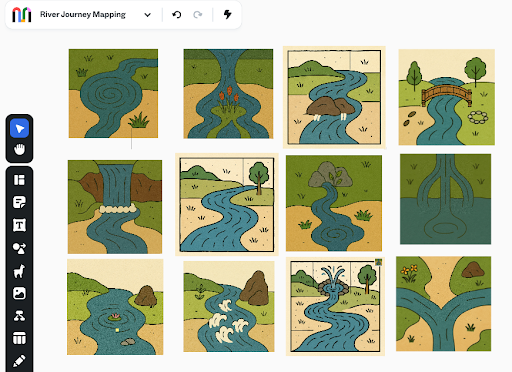
The River Journey Mapping activity offered a visual way for educators to reflect on their professional journeys and pedagogical approaches, by asking–how would you describe/visualize your journey as an educator working with Indigenous communities? The activity surfaced values, beliefs, and moments of transformation that shaped educators’ journeys. Many of the maps created through this activity highlight the importance of nourishment, with water seen as flow of energy, amniotic fluid, and love.
Here are some excerpts of participants’ responses.
The number one thing that transformed me in my work, and it was Dr. John Borrows…he taught me that the Anishinaabe word for love is like the mouth of a river. How he explained it to me was that it’s the source from which all life comes from, and so the mouth of the river is the most ecologically variant, diverse, abundant…When you reframe love as the source from which all life comes from, it’s easy to show up in relationship to it. So that’s the type of river that I see: that huge alluvial fan, and that it just flows from there.
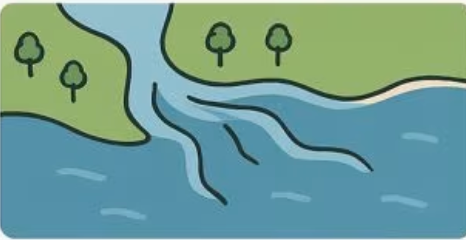
Other educators related the water flow as two separate flows or distinct watersheds, parallel rivers, or the Two Row Wampum.
…two rivers that kind of, like, sometimes they come together, and sometimes they fall apart… there’s a certain kind of, like, swampiness that’s emerging…and then it flows out separate.
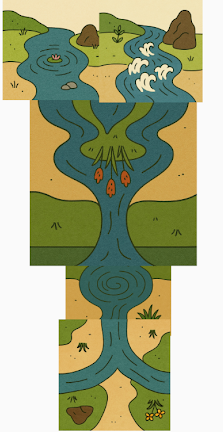
There are images of letting go of control; for instance, allowing knowledge to swirl like a whirlpool so that learners have the agency to take what they need for their learning.
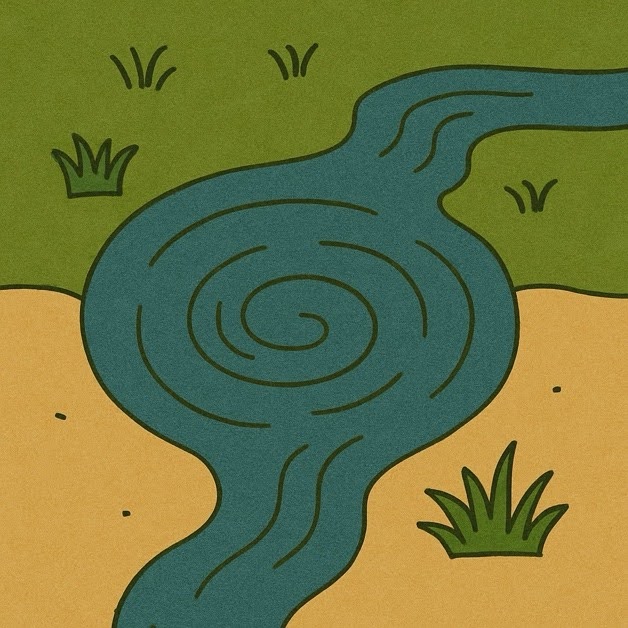
What I’ve come to understand is central to Indigenous knowledge transmission, where there’s knowledge flowing and swirling around. But it’s not up to us to try and control or dictate what people take from it…it’s about holding that space for that movement, or clearing and holding that space for that movement…Learners have agency, and ultimately for me the more important thing is not to get them to regurgitate content that I’ve introduced them to. It’s more about, through being put in these spaces of learning with knowledge flowing all around, what have they learned skill-wise to be able to take something away from that.
And there are some people who will go through that whirlpool or that water space and leave stronger and more curious, wanting to come back in and engage with it more. And then there are some people who are going to get out and be like, “I hate being wet,” and stay out. And that’s fine too. Again, it’s about letting go of that control, offering things, but then letting the context guide people to take away what they need.
The River Journey Mapping offers a way to surface deeper insights and a deeper understanding of how educators navigate their work. To further support this exploration, I developed a facilitator’s guide that can be adapted for use in different contexts. The activity uses river imagery and metaphor as a starting point; however, there are a variety of methods (drawing, mapping, storytelling, music, poetry, drama, or other creative forms) that can open space for reflection that is often difficult to access through words alone.
References
Burnard, P. (2012). Rethinking Creative Teaching and Teaching as Research: Mapping the Critical Phases That Mark Times of Change and Choosing as Learners and Teachers of Music. Theory Into Practice, 51(3), 167–178.
Escobar, A. (2024). Feeling-Thinking with the Land. Transitions: Transatlantic bridges for designing networks between Souths and Norths. Re-visiones, 10.
Hill, T., Wright, L. & Etmanski, C. (2025). Cultivating Relationality and an Ethics of Care through Arts-Based and Play-Based Research. The Canadian Journal for the Study of Adult Education / La revue canadienne pour l’étude de l’éducation des adultes, 37(1), 75–91.
Lee, L., Currie, V., Saied, N., & Wright, L. H. V. (2020). Journey to hope, self-expression and community engagement: Youth-led arts-based participatory action research (PAR) for social change. Children and Youth Services Review, 109, 1–10.
Michell, H. (2012). The Canoe Trip: A Northern Cree Metaphor for Conducting Research. In Education, 18(1).
Stevenson, K. (2013). The river in a landscape of creative practice: Creative River Journeys. Landscapes: The Journal of the International Centre for Landscape and Language, 5(2).