
About the Series
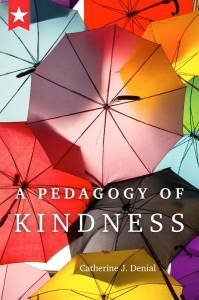
In a time marked by polarization, uncertainty, and rapid change, kindness may be one of the most important guidelines for navigating our work as educators. This April, join our Learning and Teaching team for a four-week book club exploring A Pedagogy of Kindness by Catherine J. Denial. Denial defines a pedagogy of kindness as, “about attending to justice, believing people, and believing in people. It’s a discipline.” The author wrote this book hoping that, “together we can create bright new spaces, rooted in compassion, in which all of us engaged in teaching and learning will thrive.” The book club aims to emulate that space as we read and reflect together.Schedule & Topics
The book club will meet weekly on Tuesdays, 11:00 a.m.-12:00 p.m PT for synchronous online discussions. Each session will focus on one section of the book:- April 7, Week1: Kindness toward the Self
- April 14, Week 2: Kindness and the Syllabus
- April 21, Week 3: Kindness and Assessment
- April 28, Week 4: Kindness in the Classroom
 In addition to our live sessions, participants are invited to engage asynchronously through our Moodle site. Discussion prompts will mirror those used in the synchronous sessions, offering flexible ways to participate and reflect. Asynchronous participation is optional.
 Who Should Join?
Any post-secondary educator who has already read the book, or would like to read it, is warmly invited. Whether you are new to the idea of a pedagogy of kindness or already exploring compassionate teaching practices, this book club offers a collegial space for reflection, dialogue, and shared learning. Join our team (and invite YOUR team) as we consider how kindness, justice, and belief in one another can shape bright new spaces for teaching and learning.Register Now!
This event will not be recorded.About the Facilitator
Your facilitator for these discussions will be Helena Prins, Advisor, Learning & Teaching, BCcampus. BCcampus is a proud member of the Sunflower Hidden Disabilities initiative. If you have a hidden disability that might affect your participation, you can download a virtual sunflower background to indicate that you may need a helping hand, understanding, or more time. If you require any support or have any questions, email sunflower@bccampus.ca
 About the Session
This technically-oriented session introduces offline GenAI and highlights reasons one might choose it over commercial options like ChatGPT or Gemini. We will discuss the limitations of these offline options, showcase applications to run models locally on your computer, recommend local GenAI models depending on the objective, and examine pedagogical considerations.
By the end of this session, participants will:
- Understand the advantages of using offline GenAI versus commercial online options
- Consider the limitations of hardware and local models
- Choose local GenAI models based on their specific objective
- Identify applications used to run offline GenAI
This session is one of a two-part series on offline GenAI along with Supporting vs. Doing Student Work Experiments with Offline AI in the Classroom on May 14. You can register for one or both sessions.
This webinar is part of the Opterna GenAI project funded by the Hewlett Foundation.
Register Now!
This session may be recorded, archived, and shared after the event.
About the Facilitators
Dr. Elizabeth Childs is Professor and Program Head of the MA in Learning and Technology program in the School of Education and Technology at Royal Roads University. She holds a PhD in Educational Technology from the University of Calgary. Elizabeth is interested in the design, creation, and implementation of flexible learning environments incorporating the affordances of information and communication technology and provide learners with increased choice, flexibility, and opportunities. Dr. Childs’ research interests include open educational practices; creation of, and engagement in, online learning communities and digital habitats; design thinking and maker pedagogy; and models for training and professional development.
Harper Friedman is a Coordinator of Open Education at BCcampus. With a background in computer science, Harper is able to combine his technical knowledge with his experience in open education. Since the boom in GenAI, he has been exploring ways to harness this technology while staying aligned with values of accessibility, equity, environmentalism, and agency.
BCcampus is a proud member of the Sunflower Hidden Disabilities initiative. If you have a hidden disability that might affect your participation, you can download a virtual sunflower background to indicate that you may need a helping hand, understanding, or more time. If you require any support or have any questions, email sunflower@bccampus.ca
About the Session
This FLO MicroCourse uses a design sprint approach to help educators redesign a single assessment into AI-resilient versions. Here, AI-resilient means assessments structured so students cannot fully
outsource the work to GenAI without engaging in critical thinking, decision-making, and authentic learning. The MicroCourse follows a five-step sprint approach: understand & empathize, define & frame, ideate & create, prototype & refine, and rest & pitch. Participants will apply sprint methods such as “build to think” prototyping, and structured peer-reviewed testing.
Over five days, educators will complete guided asynchronous sprint work, supported by two synchronous sessions designed to build community, strengthen collaboration, and facilitate open peer feedback.
By the end of this course, participants will be able to:
- Identify AI-related vulnerabilities in assessment tasks and clarify the learning outcomes the assessments are intended to measure.
- Apply sprint methods to ground assessment decisions in learner needs and real-wor
 ld learning contexts.
 - Generate and prioritize multiple redesign options that support meaningful learning.
- Prototype an AI-resilient assessment and refine it through structured, constructive peer feedback.
- Publish the redesigned assessment as an OER contribution to an AI-resilient assessment bank that supports teaching and learning.
What to expect
This is not an “off the side of your desk” learning opportunity. To get the most out of this learning experience, we recommend participants dedicate at least six to eight hours over the week. Participants should come prepared with one assessment (or a set of course assessment activities) to redesign. The sprint model requires iterative work, collaboration, and active participation in giving and receiving peer feedback.
While most of the learning will happen asynchronously, we are offering two optional synchronous sessions:
- Monday, April 27, 2026, 2:00–3:30 p.m.
- Wednesday, April 29, 2026, 11:00 a.m.–12:30 p.m.
Register Now!
This session will be recorded, archived, and shared with course registrants.
About the Facilitators
Your FLO Facilitators for this session will be Drs. Gwen Nguyen and Helena Prins.
BCcampus is a proud member of the Sunflower Hidden Disabilities initiative. If you have a hidden disability that might affect your participation, you can download a virtual sunflower background to indicate that you may need a helping hand, understanding, or more time. If you require any support or have any questions, email sunflower@bccampus.ca
About the Session
Are you interested in open pedagogy and teaching practices supporting social justice? Join this webinar to learn from a study examining faculty experience using open pedagogy to support social justice in their online classes.
While open pedagogy is often assumed to support social justice, this is not always the case. This webinar will provide insights on how faculty members at a B.C. post-secondary institution conceptualize social justice and how they put it into practice. Participants will also learn about a social justice-informed model of open pedagogy.
Register Now!
This session will be recorded, archived, and shared.
About the Facilitator
Melissa Ashman is an instructor of applied communications, public relations, and entrepreneurial leadership at Kwantlen Polytechnic University. An advocate for all things open, she has adapted and created open textbooks, developed and used open pedagogy assignments and practices, and completed research on open education. In 2025, she completed her doctor of education in distance education from Athabasca University. Her dissertation examined the intersection of open pedagogy, social justice, and online classes.
BCcampus is a proud member of the Sunflower Hidden Disabilities initiative. If you have a hidden disability that might affect your participation, you can download a virtual sunflower background to indicate that you may need a helping hand, understanding, or more time. If you require any support or have any questions, email sunflower@bccampus.ca
About the Session
Lee Sentes will share his recent experience integrating offline AI use into a graduate tourism course at Royal Roads University. In this initial experiment, students used offline AI to get guidance on assignment deliverables without having the AI complete the work for them. The AI essentially acts as a study tutor, with the instructor exercising significant control over how it responds.
Is it perfect? No – but it’s promising. The set up is surprisingly easy, and students who used it effectively suggest further exploration of this approach is justified.
This session is one of a two-part series on offline GenAI along with Introduction to Offline GenAI on April 20. You can register for one or both sessions.
This webinar is part of the Opterna GenAI project funded by the Hewlett Foundation.
Register Now!
This session may be recorded, archived, and shared after the event.
About the Facilitators
Lee Sentes is an Associate Faculty member at Royal Roads University and is regularly contracted to instruct a variety of courses within the Leadership, Global Leadership, Business and Commerce, and Tourism programs. Many of the courses he teaches focus on organizational development, communication, leadership, social enterprise, and design thinking. Lee is a skilled facilitator and has worked with a variety of government ministries and not-for-profit organizations focused on both the domestic service delivery and international development arenas. His consulting through Development Action and Doing Good for Nothing has focused on not-for-profits and social enterprise organizations, including various medical support agencies on Vancouver Island. He can be found on LinkedIn.
Dr. Elizabeth Childs is Professor and Program Head of the MA in Learning and Technology program in the School of Education and Technology at Royal Roads University. She holds a PhD in Educational Technology from the University of Calgary. Elizabeth is interested in the design, creation, and implementation of flexible learning environments incorporating the affordances of information and communication technology and providing learners with increased choice, flexibility, and opportunities. Her research interests include open educational practices; creation of, and engagement in, online learning communities and digital habitats; design thinking and maker pedagogy; and models for training and professional development.
BCcampus is a proud member of the Sunflower Hidden Disabilities initiative. If you have a hidden disability that might affect your participation, you can download a virtual sunflower background to indicate that you may need a helping hand, understanding, or more time. If you require any support or have any questions, email sunflower@bccampus.ca
About the Session
New tools, including AI, can reshape how we teach—but they don’t define why we teach. A teaching philosophy statement clarifies your core beliefs about teaching and learning, giving purpose and direction to your decisions in any context.
Whether you’re drafting your first teaching philosophy statement or revisiting an existing one, finding clear, meaningful guidance online can be overwhelming. This course streamlines the process by curating a focused set of high-quality resources and guiding you through a structured process—from generating ideas to developing a draft and engaging in peer feedback. You can follow the course sequentially or choose the activities that best align with your goals and timeline. By the end of the week, you’ll have a practical, adaptable teaching philosophy statement that clearly reflects and supports your teaching practice.
While most of the learning will happen asynchronously, we have a planned synchronous session planned to kick off the week:
Tuesday, May 19, 2026 | 11 a.m.–12:30 p.m.
We would like to thank University of British Columbia for their partnership in bringing this MicroCourse to B.C. post-secondary educators.

Register Now!
This session may be recorded, archived, and shared.
About the Facilitators
Dr. Megan Robertson is an Educational Consultant at the University of British Columbia’s Centre for Teaching, Learning and Technology. She has worked with undergraduate and graduate students, staff, and faculty at institution in British Columbia and Alberta.
Dr. Helena Prins is a Learning & Teaching Advisor at BCcampus and coordinates the Facilitating Learning Online (FLO) portfolio. She began her career as a high-school teacher in South Africa. Over the past 20 years, Helena has taught students of all ages and stages on four continents. A golden thread throughout her teaching experiences has been breaking down barriers to learning. Helena holds an EdD in Adult Learning from the University of Calgary.
BCcampus is a proud member of the Sunflower Hidden Disabilities initiative. If you have a hidden disability that might affect your participation, you can download a virtual sunflower background to indicate that you may need a helping hand, understanding, or more time. If you require any support or have any questions, email sunflower@bccampus.ca

The British Columbia Open Education Community (BCOEC) welcomes members from the post-secondary sector in British Columbia and the Yukon. This community convenes monthly in virtual gatherings, fostering an environment for sharing insights, providing support, and engaging in discussions about the challenges, best practices, and current issues within open education.
Register now!
Recordings and transcripts available from past meetings: B.C. Open Education Community (Playlist)
About the Workshop
Join us in person or online for the ETUG Spring Workshop 2026: “Collaboration, Co-creation, and Creativity in Ed-Tech: Responding to Change” on May 28–29, 2026!
The changing landscape of post-secondary education in B.C. is forcing institutions to alter their approach to learning design and delivery, as well as student support. Increasingly, we are asked to leverage technology to meet these new demands. In addition, we recognize the need to demonstrate the value of our work in providing ed-tech support and solutions to our institutions. Meeting these demands requires collaboration, co-creation, and creativity.
Location
The workshop will be held in person at Langara College – 100 West 49 Avenue in Vancouver, B.C. and will also be streamed online.
The BCcampus Travel Grant is available for B.C. post-secondary educators and instructional support staff who require funding for travel and professional development and who wish to attend the ETUG Spring 2026 Workshop. Apply by May 10, 2026.
Rates
Two-day registration only
- In-Person: $250 CAD + 5% GST
- Online: $25 CAD + 5% GST
- In-Person (Student): First five free
- Online (Student): Free
Register Now!
In-person registration closes on Wednesday, May 14, 2026 at 11:59 p.m. PT
Online registration closes May 29, 2029 at 12:00 p.m. PT
This session may be recorded, archived, and shared after the event.
BCcampus is a proud member of the Sunflower Hidden Disabilities initiative. If you have a hidden disability that might affect your in-person participation, please take a Sunflower lanyard available at our registration desk. Staff wearing the Sunflower have been trained to respond respectfully and appropriately when support is requested. If you are participating virtually, you can download a virtual sunflower background to indicate that you may need a helping hand, understanding, or more time. If you require any support or have any questions, email sunflower@bccampus.ca
BCcampus is hitting the road again!
From June 1–10, 2026, we’re visiting regional post-secondary institutions to explore exciting topics in higher education, including learning and teaching trends, curriculum design, artificial intelligence, digital literacy, open education, and more! Each stop on the BCampus Regional Roadshow will feature a customized selection of workshops, sessions, and topics in our signature style of caring, inclusive, and engaging learning spaces.
Come visit us in person! We’re making stops at Vancouver Island University in Nanaimo, North Island College in Comox Valley, and Coast Mountain College in Prince Rupert and Terrace.
Registration is free and open to all educators and learners. Be sure to register and join us at one or more stops.
Learn More!
About the Event
Join us for this 90-minute virtual workshop in partnership with the University of Victoria.
As Generative AI (GenAI) tools, including educational tools, become increasingly integrated into our technology, educators face complex decisions about how, when, and whether to incorporate them into teaching and learning. This workshop employs the Indigenous 5Rs framework—Respect, Relevance, Reciprocity, Responsibility, and Relationships—as a reflective model to guide critical evaluation of GenAI’s role in educational contexts such as course design, learning activities, and assessment practices. The framework provides language and reflective practices for educators to articulate principled, context-specific decisions about GenAI adoption, constraint, or refusal, and consider how these same lenses can support students’ critical and ethical decision-making about their own engagement with GenAI tools.

Register Now!
This session may be recorded, archived, and shared after the event.
About the Facilitators
Alexander Warrington is the Manager of Educational Technology Support at the University of Victoria where he has spent the past five years helping instructors and students use educational technologies with confidence and explore the impact of GenAI on teaching and learning. He has also taught Biomedical Ethics and Professional Communication in Camosun College’s Allied Health programs. Alex enjoys exploring how technology and learning science can come together to make education more engaging and meaningful.
Dr. Christian Bock serves as Director, Teaching and Curriculum Innovation at the University of Victoria’s Division of Learning and Teaching Innovation (LTI), where he supports instructors and departments in advancing effective, inclusive, and student-centred teaching; as a white settler, he acknowledges the privilege of living, working, and learning on the traditional territories of the Lekwungen and Songhees peoples. With 20+ years of experience in international secondary and post-secondary education, his work focuses on curriculum development, experiential learning, academic integrity, and fostering ethical, self-regulated learning, and research-informed practice to support educators navigate the evolving landscape of higher education.
BCcampus is a proud member of the Sunflower Hidden Disabilities initiative. If you have a hidden disability that might affect your participation, you can download a virtual sunflower background to indicate that you may need a helping hand, understanding, or more time. If you require any support or have any questions, email sunflower@bccampus.ca